


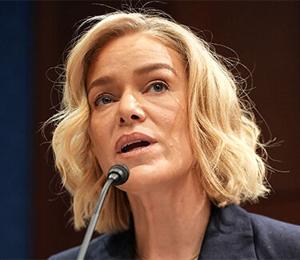
Katherine Maher’s first year as CEO of NPR has coincided with the most disruptive period public broadcasting has faced in decades, as political attacks, internal divisions and the loss of more than $500 million in federal funding reshaped the system that supports public radio and television.
Maher, who took the helm in 2024, was quickly pulled into controversy. Early in her tenure, senior editor Uri Berliner published an essay in The Free Press accusing NPR of liberal bias. NPR publicly disputed the claims, with “Morning Edition” host Steve Inskeep issuing a rebuttal citing factual errors. Berliner later exited the network, but the episode intensified scrutiny of NPR’s journalism and leadership.
That scrutiny grew when conservative activist Chris Rufo resurfaced years-old social media posts from Maher criticizing former President Trump and supporting progressive causes. Republicans in Congress seized on the posts, calling Maher to testify and questioning NPR’s objectivity. NPR said the posts predated Maher’s work in journalism.
Asked whether she considered stepping aside, Maher told The New York Times, “I really don’t like bullies,” adding that she believed the broader mission of NPR outweighed the pressure she faced early in her tenure.
Defunding Becomes Inevitable
Political pressure soon gave way to a more existential threat. Following President Trump’s re-election, public media leaders warned that Congress could eliminate federal funding for NPR and PBS through the Corporation for Public Broadcasting (CPB).
While NPR and PBS could survive without federal support — relying primarily on underwriting, member dues and donations — the impact on local stations was far more severe. Many stations rely on CPB funding for a majority of their operating budgets.
In March, Maher and PBS CEO Paula Kerger testified before Congress in a hearing titled “Anti-American Airwaves: Accountability for the Heads of NPR and PBS.” Republicans pressed Maher on her social media posts and editorial decisions, while Democrats defended public broadcasting.
As funding cuts loomed, advocacy groups circulated compromise proposals aimed at preserving station funding by reducing support for national programming. One internal document asked bluntly, “How big of a cut could we tolerate?”
Break With CPB Leadership
Those discussions unraveled amid rising tension between NPR and CPB leadership. During a call this spring, CPB President and CEO Patricia Harrison asked Maher whether she would publicly acknowledge concerns from critics who viewed NPR’s reporting as biased, according to people familiar with the exchange.
Maher refused, arguing that NPR’s journalism did not warrant such a concession and that it would undermine the organization without satisfying critics. The disagreement escalated, and Harrison ultimately told Maher she should resign for the good of public media, according to multiple sources.
Shortly afterward, President Trump issued an executive order barring federal funding of NPR and PBS. NPR sued the White House, calling the order unconstitutional, and later added CPB as a defendant after the order directed the corporation to deny NPR funding.
Maher said the administration’s actions tied funding directly to editorial decisions. “Once that happened,” she said, “compromise was no longer an option.”
Senate Vote and Fallout
In July, the Senate voted 51-48 to defund public media. Maher told employees NPR had mounted a “David-and-Goliath-style” effort, holding 191 meetings during a Washington lobbying push. NPR followed with fundraising appeals that produced record donations.
Local stations, meanwhile, announced layoffs and budget reductions. NPR reported increased broadcast listening – up roughly 8%, according to Radio Research Consortium data — and growing digital reach, driven in part by Tiny Desk Concerts on YouTube.
Tensions with CPB deepened in September when the corporation awarded a major radio distribution grant to Public Media Infrastructure, a new coalition backed by WNYC, PRX and others. NPR viewed the move as politically motivated and sought a restraining order to block the funding shift.
“Mom and Dad are fighting,” one public media executive said at the time.
NPR’s board overwhelmingly backed Maher, approving the legal action despite concerns it would further fracture public media.
Settlement and a Weaker System
In November, NPR and CPB reached a settlement restoring partial funding for NPR’s satellite distribution system and declaring the executive order unconstitutional. NPR also announced temporary fee relief for member stations.
CPB is scheduled to wind down in January, and some stations have opted to disaffiliate from NPR and PBS entirely.
Despite the upheaval, NPR’s business remains stable. Maher said NPR saw record donations in 2025 and will provide $22 million in direct financial support to member stations.
“The system is weaker overall,” Maher said, “but NPR remains on firm footing.”
Source link